
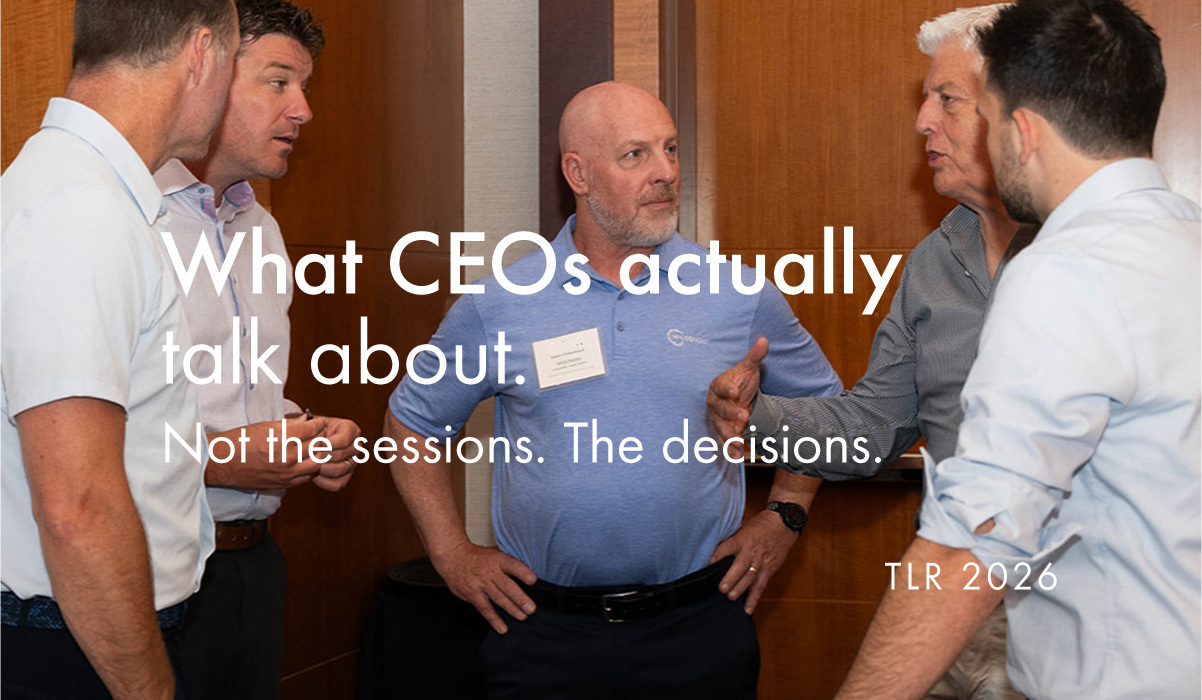
TLR 2026 | What CEOs Actually Talk About at TLR
The formal program at TLR matters. Sessions on AI integration, workforce strategy, market positioning, and leadership development. But if you asked attendees what they valued most, most would point to the conversations that happened between sessions.
Over breakfast, a CEO from Texas asks a peer from Virginia how they’re handling the labor shortage in a tight market. The answer isn’t theoretical. It’s specific: the exact compensation structure they implemented, the retention metrics six months later, and the one mistake they’d correct if they could do it over again.
At the afternoon break, three owners end up in a conversation about acquisition integration. One just closed a deal. One walked away from a deal. One is six months into post-acquisition operations. They compare notes on culture alignment, system integration, and the hidden costs nobody warns you about.
After dinner, a group gathers in the after-hours suite. Someone asks about succession planning. The conversation goes on for 90 minutes. Real numbers. Real timelines. Real concerns about whether their leadership team is ready and how to know when it’s time.
This is what we mean when we say TLR is built around peer learning.
The sessions provide frameworks and perspectives. But the real value is in the application conversations that happen when peers who are living similar challenges compare approaches.
These conversations work because everyone in the room is operating at scale. When you’re running a $15M+ operation, you’re not looking for “Landscaping 101” advice. You need specific insight on challenges that only show up at that level of complexity.
You need to know:
- How other CEOs structure their leadership teams as they scale past $30M
- What KPIs actually matter when you’re running multiple service lines
- How to evaluate software platforms when your operation is too complex for off-the-shelf solutions
- What private equity conversations actually look like when firms start approaching you
The best answers to these questions don’t come from consultants. They come from people who solved them last quarter.
One TLR attendee described the value this way: “I came with three specific challenges I was wrestling with. I left with playbooks from people who’d already navigated all three.”
That’s the difference between education and calibration. Education gives you concepts. Calibration gives you confidence that your next decision is informed by people who’ve already made it.
When we surveyed attendees after TLR 2025, 94% said the event delivered meaningful relationship-building opportunities that justified their investment. That’s what happens when you design an event around peer connection rather than keynote consumption.
Thought Leaders Retreat 2026
July 27-29 | Arlington, Texas
[Learn more about TLR 2026] | [email protected] | 414-349-3382
Presented by Wilson360 and LandScaling