
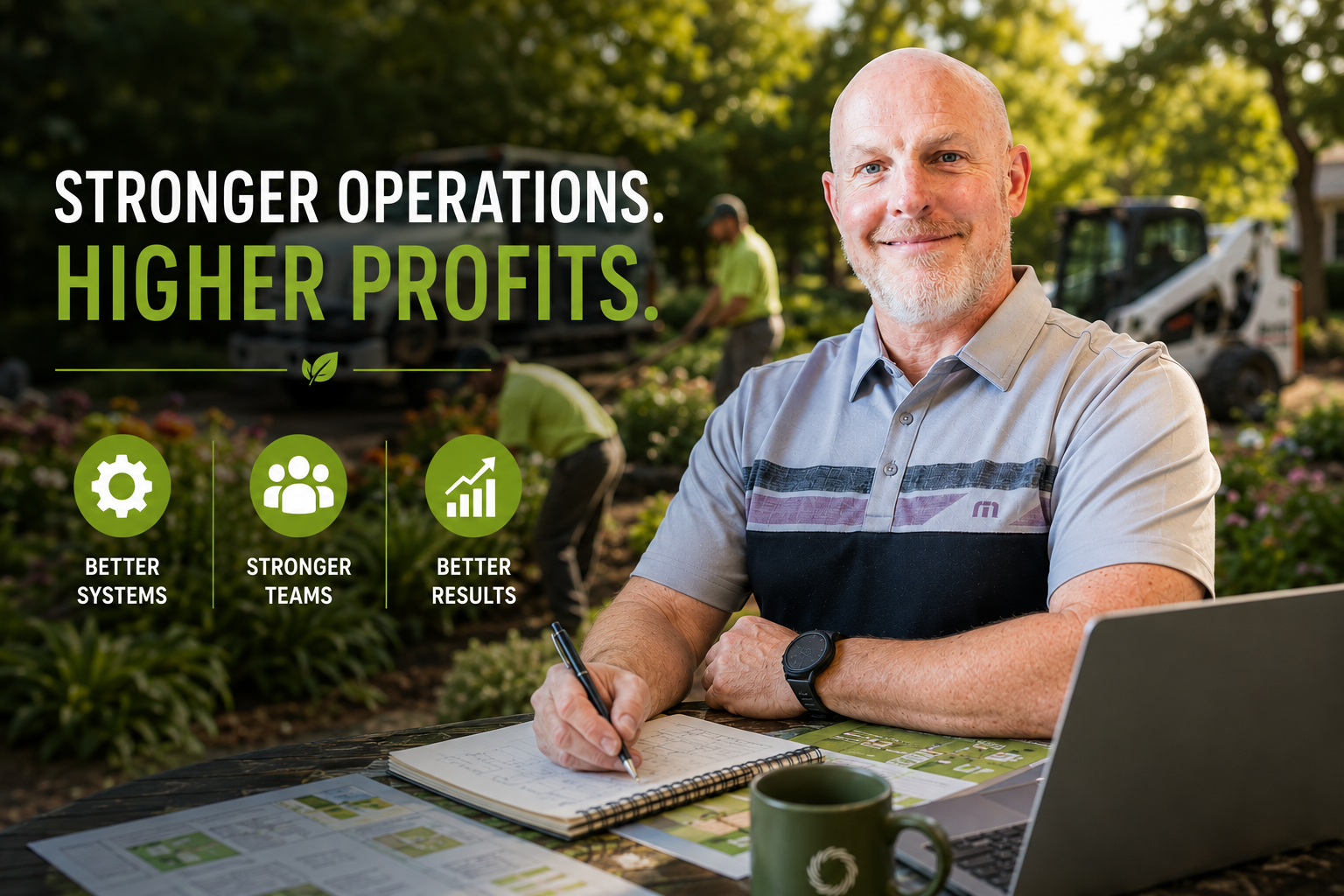
How Landscape Business Coaching Improves Operations and Profitability
Running a landscape company is genuinely hard. You are managing crews, chasing estimates, handling customer expectations, watching weather wreck your schedule, and somehow trying to find time to think about the future of the business. Most owners did not get into this industry to become full-time managers — they got in because they love the work. Over time, the business grows and the problems grow with it, and at some point, gut instinct alone is not enough to move things forward.
That is where working with a landscape business consultant changes the equation.
The Real Operational Problems Most Landscape Companies Share
Before talking about what coaching and consulting can do, it helps to name what actually goes wrong. Across the green industry, the patterns are remarkably consistent. Margins are tighter than they should be because estimates are inconsistent or pricing has not kept pace with costs. Middle managers were promoted because they were good in the field, not because anyone developed them as leaders. The owner is still the bottleneck — every major decision runs through them. And growth, when it happens, tends to create chaos rather than confidence.
These are not personal failures. They are structural ones. And they are exactly what landscape business consulting is designed to address.
What Good Landscape Business Coaching Actually Looks Like
There is a version of coaching that feels a lot like motivational content with a worksheet attached. That is not the kind of work that moves the needle for landscape company owners.
Effective landscape business coaching gets specific. It starts with an honest look at where the business stands — financials, operations, people, and culture. From there, it builds a realistic plan that connects daily decisions to longer-term outcomes. Think improved job costing practices, clearer accountability across the org chart, better hiring frameworks, and pricing strategies that actually protect margin.
At Wilson360, that kind of structured, industry-focused work is the foundation. The goal is not to make landscape companies look better on paper — it is to help them run better every day.
Leadership Development Is Not Optional Anymore
For a long time, leadership development felt like something big corporations did. For a 30-person landscape company, it seemed like a luxury. That thinking has shifted — and for good reason.
The labor market in the green industry has made it clear: people leave managers, not companies. When a foreman does not know how to give clear direction, retain trust, or handle conflict, the crew feels it and turnover follows. Leadership development for CEOs and their management teams is now a core operational investment, not a soft skills add-on.
Leadership development programs built for the landscape industry look different from generic corporate training. They account for the pace of the season, the diversity of the workforce, and the specific pressures landscape managers face. Wilson360 designs programs that meet owners and their teams where they actually are — and builds from there.
Why Peer Groups Work for Landscape Leaders
One of the most underestimated tools in landscape business growth is also one of the oldest: talking to people who understand your situation.
Peer groups for landscape leaders create structured environments where non-competing owners and executives can be honest about what is working and what is not. There is no posturing. No sales pitch. Just real conversations about real business problems — cash flow, succession planning, team development, market expansion — among people who have skin in the same game.
Wilson360’s peer group model, including CEO-level forums and groups for leaders and managers, is built specifically for the green industry. Members report that the accountability and perspective they get from the group often drives decisions they had been avoiding for years.
Operations and Profitability Are Connected — You Cannot Fix One Without the Other
Here is something that comes up in nearly every engagement: owners who want to improve profitability focus on revenue, but the real issue is usually operational. Routes are inefficient. Job time estimates are too low. Equipment downtime is eating labor hours. The problem is not sales — it is that the machine running the business has too many leaks.
A good landscape business consultant helps owners see both sides clearly. Revenue strategy matters. So does knowing your actual cost per crew hour. So does having the right people in the right roles with the right training. When those pieces align, profitability follows — and it tends to hold.
Wilson360 works with landscape companies at different stages — some are pushing past $2M and trying to build infrastructure, others are at $10M+ and working through delegation and leadership succession. The approach adapts, but the discipline stays the same: clear data, honest assessment, and a plan built around what the business actually needs.
The Business You Want to Run Is Closer Than It Looks
Most landscape company owners have a clear picture of what they want their business to become. A business that does not rely entirely on them. A team that takes ownership. Margins that reflect the quality of work they deliver. A company that runs well and keeps growing.
That version of the business is not a fantasy — but it does not happen by accident. It takes the right structure, the right support, and often the right outside perspective to see what you cannot see from inside the operation.
That is what Wilson360 is built to provide — for landscape companies ready to grow with intention.
Frequently Asked Questions
What does a landscape business consultant actually do?
A landscape business consultant works with owners and executives to identify operational inefficiencies, strengthen team structures, build financial accountability, and create a clear growth plan. The work is hands-on and specific to the green industry.
How is landscape business coaching different from general business coaching?
Landscape business coaching is built around the real challenges of the green industry: seasonal cash flow, crew retention, estimating accuracy, and service diversification. A general coach may not understand those nuances. Industry-specific coaching closes that gap.
What are CEO peer groups and how do they help landscape company owners?
CEO peer groups bring together non-competing landscape executives to share challenges, benchmark performance, and hold each other accountable. For many owners, it is the first time they have had a trusted group of peers who truly understand their business.
How long does it typically take to see results from landscape business consulting?
Most companies begin to see measurable operational improvements within the first 90 days. Profitability gains and leadership culture shifts tend to take six to twelve months of consistent work, depending on company size and starting point.