
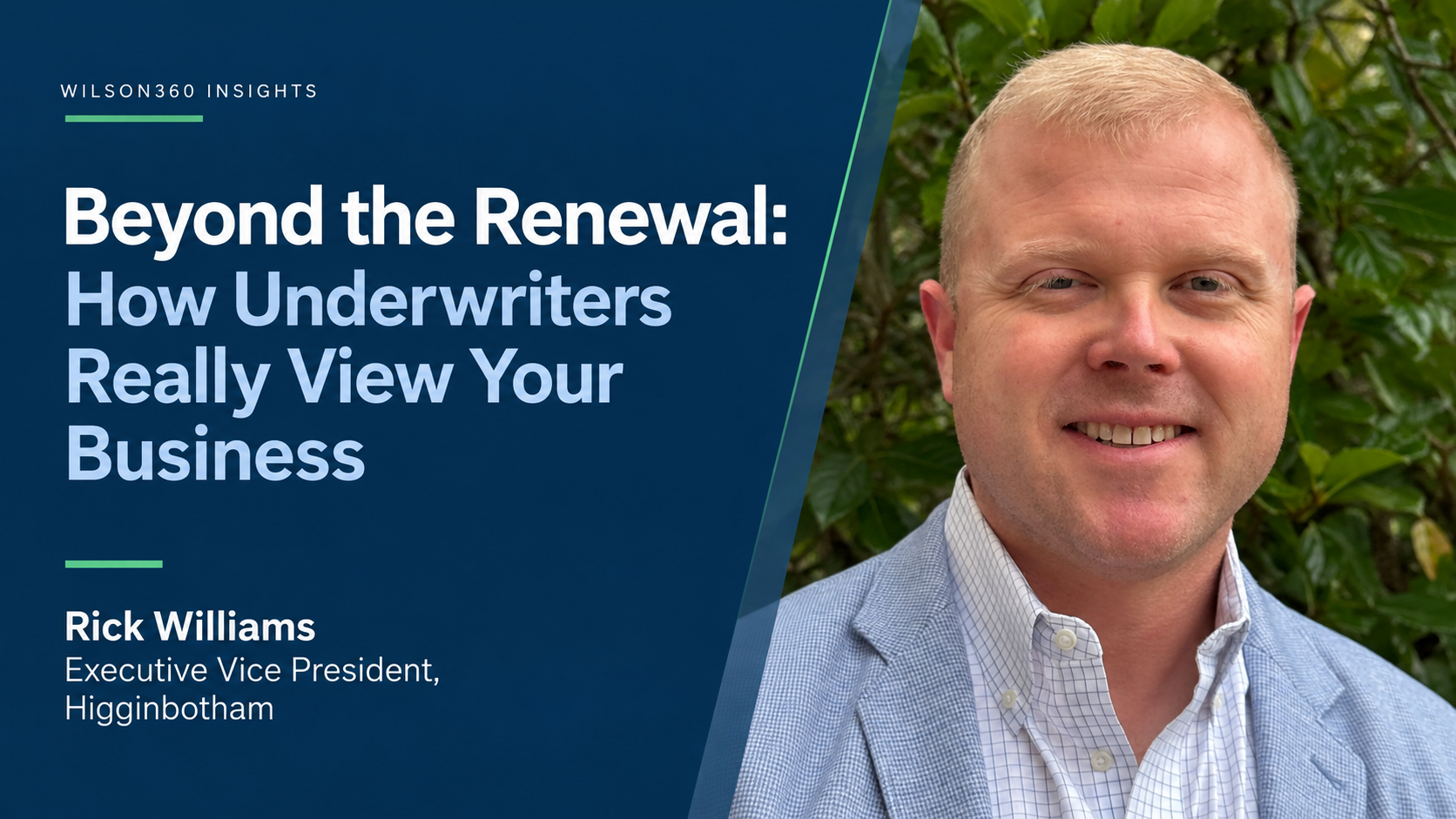
Beyond the Renewal: How Underwriters Really View Your Business
By Rick Williams, Executive Vice President, Higginbotham
The traditional insurance buying process was largely designed around annual transactions, not long-term business outcomes.
For many companies, this standard approach is familiar: gather renewal information 60–90 days before expiration, market the account, compare quotes, negotiate terms, and repeat the cycle the following year. That process may create the appearance of competition, but it rarely creates meaningful strategic improvement. Shopping insurance does not fundamentally change the underlying drivers that determine cost, insurability, or carrier appetite. Most business owners do not have an insider view of how insurance is actually purchased.
The reality is that underwriting decisions are not built around a single renewal cycle/annual basis. Carriers often evaluate multiple years of loss experience (claims), operational trends, management discipline, financial steadiness, and evidence of long-term risk management. Yet many insurance relationships are still managed as annual purchasing exercises rather than multi-year business strategies.
This creates a disconnect. If carriers evaluate your business over a three- to five-year horizon, why are so many insurance programs managed one year at a time?
A more strategic approach starts with aligning incentives around reducing the total cost of risk—not simply negotiating premium. Premium is an output. Claims frequency, claims severity, operational discipline, safety culture, contract strategy, return-to-work practices, and risk selection/avoidance are inputs.
Traditional compensation structures can also unintentionally reinforce short-term thinking. In many arrangements, broker compensation and carrier revenue are tied in part to premium volume. That does not mean agents or carriers want clients to perform poorly; most do not. But it does mean the system does not always reward risk reduction with the same intensity it rewards placing coverage.
I believe the insurance conversation should begin years before renewal, not months. The objective is to help clients become a more attractive risk over time: fewer surprises, stronger operating discipline, lower claim costs, better carrier relationships, greater optionality in the marketplace, and ultimately a lower total cost of risk.
The question should NOT be: “Who can get me the cheapest renewal this year?”
The question SHOULD be: “What does our company need to become over the next five years so the market competes to earn our business?”
If you haven’t taken this approach with your program yet, that is OK. Most folks don’t know the inside mechanics of how the insurance industry operates.
There is an old saying: “The best time to plant a tree is 20 years ago; the second best time is today.”
Many green industry owners manage risk year to year rather than looking at the big picture. To build a truly resilient landscape or lawn care business, you need a long-term strategy. To get you started, here are several critical questions designed to shift your approach from reactive to proactive.
Six Questions to Guide a Long-Term Risk Strategy
- Where are you taking your company in the next two years & what does success look like?
- Where are you taking your company in the next 5 years & what does success look like?
- Is your current risk management program aligned with your long-term company goals?
- What is the biggest risk in your business that you don’t think your competitors are managing well?
- What is the biggest risk that you haven’t solved yet?
- Where are unnecessary dollars being spent within your risk management program, and where can those dollars be redirected to better resources?
Warren Buffett put it this way:
“Someone is sitting in the shade today because someone planted a tree a long time ago.”
That quote speaks to legacy and long-term thinking. I hope something in this article helps you, your leadership team, and your company.
About the Author
Rick Williams, Executive Vice President at Higginbotham, brings more than 17 years of experience in the landscape industry and helps businesses identify, manage, and reduce risk through proactive, tailored risk management strategies.
Rick can be reached at c 912-254-1678 | e [email protected]